EN
Running poultry operations in Saudi Arabia, Egypt, or across Africa means dealing with heat that can kill birds in hours, water that costs more than feed in some regions, and infrastructure gaps that would shut down operations elsewhere. These aren’t abstract challenges—they shape every decision from site selection to daily management routines.
Agrifam builds poultry systems specifically for these conditions. The work involves climate-controlled housing that actually performs when ambient temperatures exceed 45°C, water systems designed around scarcity rather than abundance, and biosecurity protocols adapted to local disease pressures. Our projects support food security initiatives across Africa while attracting investment in Saudi Arabia’s expanding agricultural sector.
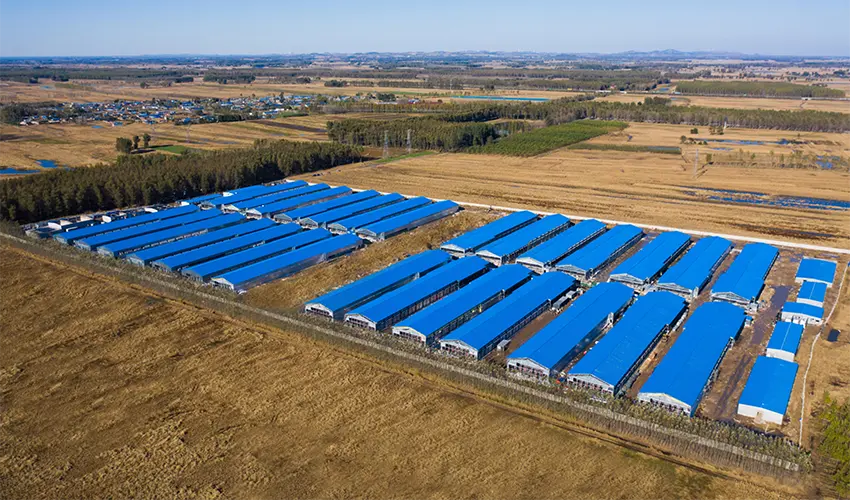
Most poultry projects fail not because of bad birds or poor genetics, but because the supply chain fragments at critical moments. Equipment arrives before buildings are ready. Financing falls through mid-construction. Local contractors lack experience with specialized agricultural systems.
Agrifam handles the entire process from initial feasibility studies through operational commissioning. This includes arranging financial support, providing technical consulting, completing detailed engineering design, and managing civil construction. We manufacture equipment, supervise installation, and return for system upgrades as operations scale.
The practical benefit is accountability. When one company owns the entire process, problems get solved rather than blamed on other parties. Food safety standards remain consistent because the same team designs processing facilities and manages logistics. Farm management systems integrate properly because they’re specified together rather than cobbled from different vendors.
Keeping birds alive and productive when outside temperatures regularly exceed 40°C requires more than basic ventilation. The physics of heat transfer in poultry housing changes dramatically in arid conditions—evaporative cooling works better when humidity is low, but water becomes the limiting resource.
Climate-controlled poultry houses in these regions need carefully balanced systems. Evaporative cooling pads provide temperature reduction, but the water consumption must be calculated against local availability and cost. Tunnel ventilation moves air efficiently, though fan placement and house orientation matter more in extreme heat than in temperate climates.
Feed formulation requires adjustment for heat stress. Birds eat less when they’re hot, so nutrient density must increase to maintain growth rates. This means reformulating rations seasonally and sometimes daily based on temperature forecasts. The goal is maintaining nutritional uptake while minimizing waste from uneaten feed.
Energy costs dominate operating budgets when cooling systems run continuously for months. Efficient poultry farm designs incorporate solar orientation, insulation values appropriate for local conditions, and equipment selection based on energy consumption rather than just purchase price.
Water scarcity isn’t a future concern in most arid regions—it’s the current reality shaping every operational decision. A single broiler house with 20,000 birds can consume 8,000 liters daily during peak summer months. Multiply that across a commercial operation, and water becomes the primary constraint on expansion.
Closed-loop water systems reduce consumption significantly by recycling cooling water and treating wastewater for reuse in non-potable applications. Efficient drinking lines minimize spillage, which matters more when every liter carries real cost. Some operations integrate water recycling technologies that capture and treat runoff for irrigation of feed crops grown on-site.
The engineering challenge is maintaining water quality while reducing consumption. Recycled water requires treatment to prevent pathogen buildup. Storage systems need protection from contamination. Monitoring equipment must track quality continuously rather than through periodic testing.
Biosecurity in poultry operations often exists on paper but fails in practice. Workers bypass disinfection stations because they’re inconvenient. Visitors enter production areas without proper protocols. Feed deliveries create contamination pathways that nobody monitors.
Effective biosecurity starts with facility design. Controlled access points force compliance because there’s no alternative route. Shower-in/shower-out requirements become practical when facilities are properly designed and maintained. Pest management works when buildings are constructed to exclude rodents and insects rather than relying on chemical control after infestation.
Poultry health management in these regions requires understanding local disease pressures. Vaccination programs must address endemic diseases while preparing for emerging threats. Veterinary services need to be available for routine monitoring, not just emergency response. The goal is preventing outbreaks rather than managing them after they occur.
Farm hygiene protocols require consistent enforcement. This means training workers, providing adequate facilities, and creating accountability systems that identify compliance failures before they cause problems.
The difference between profitable and marginal poultry operations often comes down to management decisions made daily. Which houses need attention? Where is feed conversion declining? What’s causing the mortality spike in one section?
Smart farming solutions provide answers by collecting data continuously and presenting it in actionable form. Sensors monitor temperature, humidity, water consumption, and feed usage across every house. Analytics identify patterns that human observation misses—the slight decline in water intake that precedes a disease outbreak, the temperature variation that explains uneven growth rates.
Farm automation handles routine tasks with consistency that human workers cannot match. Automated feeding systems deliver precise rations on schedule. Climate control responds to conditions faster than manual adjustment. Lighting programs optimize growth cycles without requiring constant attention.
The financial impact compounds over time. Cost reduction comes from eliminating waste, preventing losses, and optimizing resource use. Return on investment improves because the same infrastructure produces more output with lower inputs. Operations become efficient enough to remain profitable even when market prices decline.
Poultry projects require different expertise at different stages. Financial structuring demands understanding of agricultural lending and investment requirements. Design requires engineering knowledge specific to poultry housing and processing facilities. Construction requires experience with specialized agricultural buildings. Equipment installation requires technicians familiar with specific systems.
Agrifam maintains capabilities across all these areas. We provide consulting for projects from initial concept through feasibility analysis. Our engineering teams complete detailed designs that local contractors can execute. We manufacture equipment to specifications appropriate for regional conditions and supply components from established poultry equipment suppliers.
Installation services ensure systems perform as designed. This matters because poultry equipment often fails not from manufacturing defects but from improper installation. Ventilation systems underperform when fans are mounted incorrectly. Feeding systems waste feed when calibration is wrong. Climate control fails when sensors are poorly positioned.
Ongoing support includes upgrading farm technology as operations mature and new solutions become available. A system installed five years ago may benefit from updated controls, improved sensors, or more efficient components.
| Technology Feature | Benefit in Arid Climates | Recommended Equipment |
|---|---|---|
| Evaporative Cooling | Reduces internal temperatures, prevents heat stress | Climate-Controlled Poultry Houses |
| Closed-Loop Water Systems | Minimizes water consumption, promotes sustainability | Advanced Poultry Water Systems |
| Automated Feeding | Ensures precise nutrition, reduces feed waste | Precision Feeding Station |
| Energy-Efficient Lighting | Lowers electricity costs, optimizes growth cycles | LED Lighting Systems |
| Waste-to-Energy | Converts manure into biogas, reduces environmental impact | Biogas Digesters |
Heat stress kills birds and reduces productivity across both countries during summer months when temperatures regularly exceed 45°C. Water costs more than in temperate regions and availability limits expansion. Feed ingredients require importation, creating supply chain vulnerabilities and cost fluctuations. Disease pressures differ from other regions, requiring adapted biosecurity and vaccination approaches. Agrifam designs poultry farm solutions addressing each constraint through climate-controlled housing, water-efficient systems, and locally appropriate health management protocols.
Automation reduces labor requirements while improving consistency in feeding, climate control, and monitoring. Data collection identifies problems earlier, reducing mortality and treatment costs. Climate control maintains productive conditions despite external temperature extremes. Water management systems reduce consumption by 30-40% compared to conventional approaches. These technologies make African operations competitive with established producers in other regions while building sustainable production capacity.
Agrifam provides integrated services covering every development phase. This includes financial structuring assistance, technical consulting, engineering design, civil construction management, equipment manufacturing, professional installation, and ongoing technology upgrades. The single-source approach eliminates coordination problems between multiple contractors and ensures accountability for project outcomes. Contact us at 010-8591 2286 or bjhn@agrifamgroup.com to discuss your specific requirements.
Agrifam works with producers across Saudi Arabia, Egypt, and Africa who need poultry farm solutions designed for their actual conditions rather than adapted from temperate-climate templates. Our integrated approach handles complexity that fragments other projects, delivering operational facilities rather than incomplete construction sites.
Contact us at 010-8591 2286 or bjhn@agrifamgroup.com to discuss how our experience with arid-climate poultry production applies to your specific situation.







bjhn@agrifamgroup.com